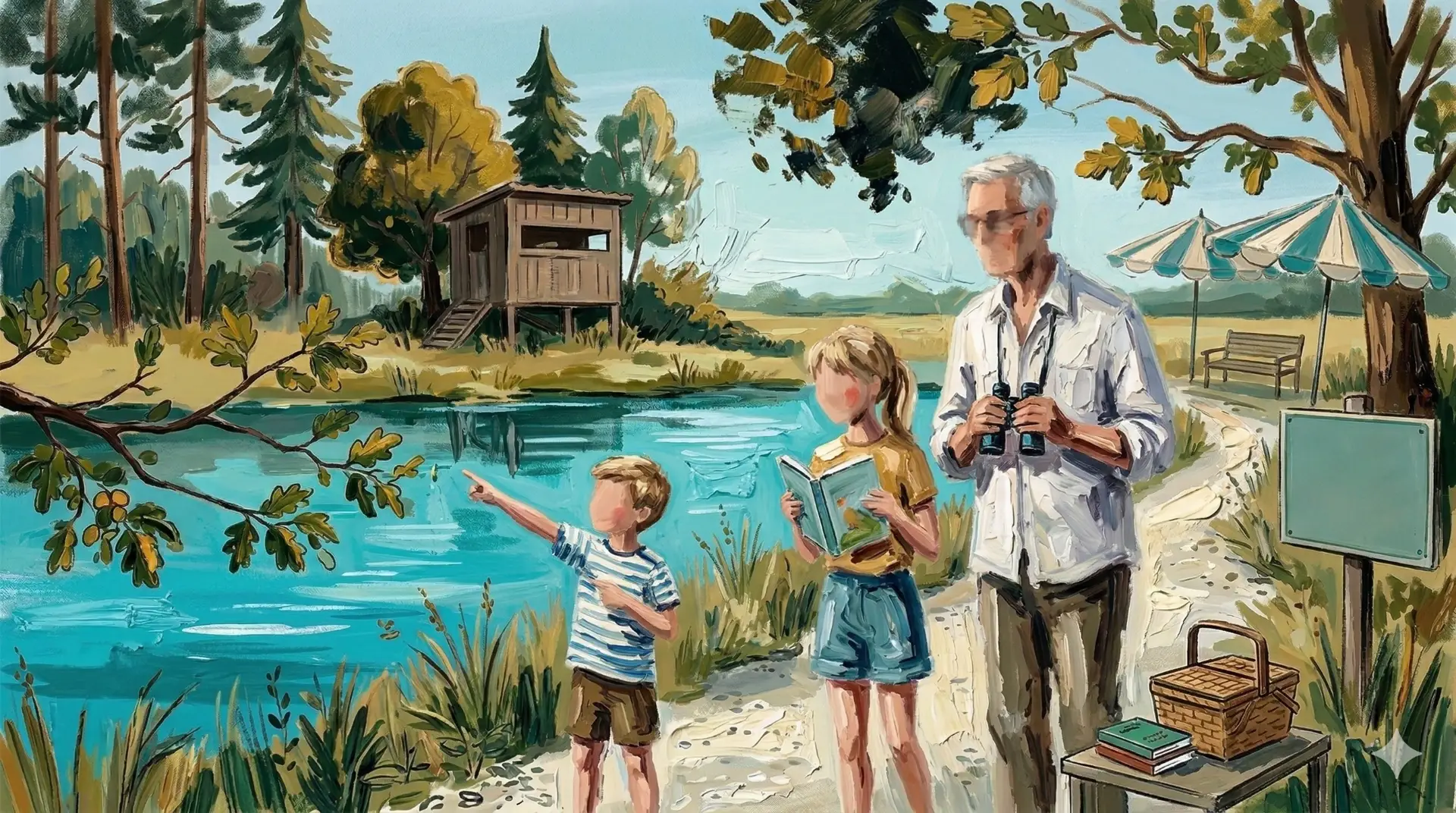
Birdwatching with Grandchildren Is The Best Screen-Free Activity You’re Probably Not Doing Yet
If you asked most grandparents what they’d like to do more of with their grandchildren, “something that gets us both outside, requires no equipment, costs almost nothing, and works whether they’re five or fifteen” would be somewhere near the top of the list.
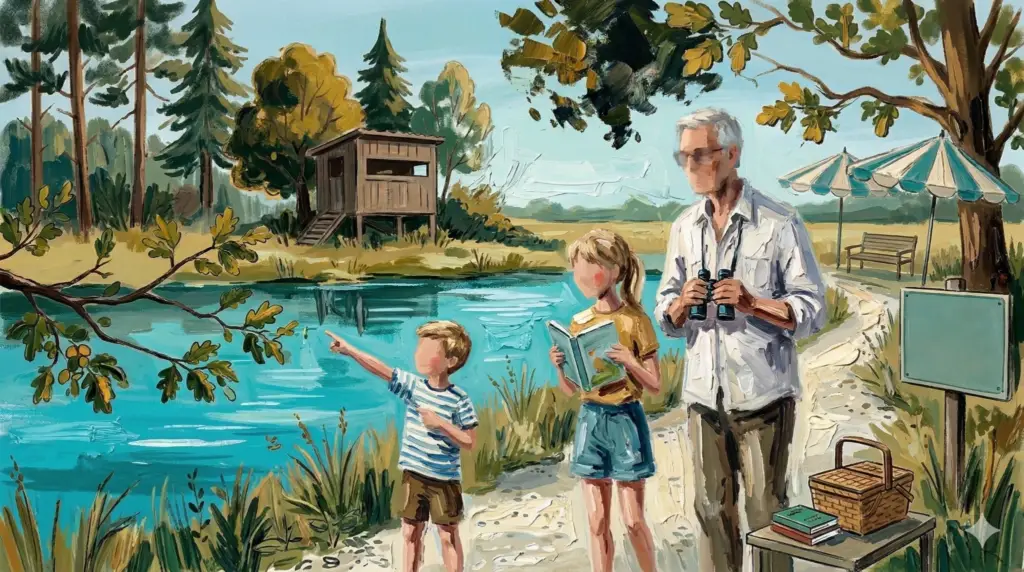
Birdwatching covers all of that and adds something most activities don’t: it creates genuine shared attention. You’re looking at the same thing together. The joy of spotting something — a kingfisher, a woodpecker, a bird of prey you weren’t expecting — lands on both of you at the same moment, and it’s the same for both of you regardless of age or expertise. That doesn’t happen much.
It also, quietly, turns off screens. Not by banning them, which tends to produce resentment, but by providing something more immediately compelling: a real wild thing, right there, doing something interesting. Most children find this more engaging than adults expect.
Why Birdwatching Works Well Across Generations
The most common criticism of birdwatching as a family activity is that children get bored. This is true of badly set-up birdwatching. It’s much less true of the approach described here, which prioritises movement and discovery over standing silently with binoculars.
The key difference is that birdwatching with children is not about waiting. It’s about walking slowly, paying attention, and noticing things. A child who is actively looking — scanning the canopy for movement, following a bird from branch to branch, trying to identify something from a field guide — is engaged in a way that standing still and being shushed is not.
Birdwatching also scales in difficulty in a way that suits mixed-age pairings. For a younger grandchild, the target might simply be to spot ten different birds and write them down. For an older one, it might be to correctly identify three new species from a field guide without help. You can be doing the same walk at completely different levels of engagement and still be doing it together.
Getting Started: What You Actually Need
- Binoculars. One pair to start, ideally 8×42 or 10×42 — numbers that indicate magnification and lens size. You don’t need expensive ones. A pair in the £40–80 / $50–100 range will work well for beginners. If you’re buying for a child to use, make sure they can adjust the focus themselves and that the binoculars aren’t too heavy for sustained use.
- A field guide. The RSPB Pocket Guide to British Birds (for UK readers) or the National Audubon Society Field Guide for your region (US readers) are both excellent and affordable. Apps are increasingly popular — Merlin Bird ID, made by Cornell Lab of Ornithology, is free, identifies birds from photographs or sound recordings, and is particularly useful for children who respond well to technology as a tool rather than an end.
- A notebook. A simple exercise book does the job. Recording what you’ve seen turns birdwatching into something cumulative — you start to build a personal list together, notice seasonal changes, track what comes back year after year. Older grandchildren often find this kind of project compelling. It’s the difference between an outing and a ongoing thing.
- Appropriate footwear and layers. Birdwatching is all-weather, which is one of its virtues, but it requires you to actually be comfortable standing and walking outdoors in whatever conditions present themselves. Sort this out before you go, not on the day.
Where to Go
You don’t need to travel anywhere special to start. Birdwatching can begin in a garden, a local park, a canal towpath, or a nature reserve ten minutes from home. The key is consistency — returning to the same places builds familiarity, and familiarity is what lets you notice when something new appears or something familiar is missing.
For garden birdwatching: Put up a simple bird feeder, the kind that takes sunflower seeds or suet balls. Watch what comes to it. In most parts of the UK you’ll see blue tits, great tits, robins, chaffinches, house sparrows, and starlings within the first week. In the US, the species vary by region but the principle is identical. Give your grandchild the job of refilling the feeder on visits and keeping the notebook. This creates a reason to pay attention and something to come back to.
For outings: Most countries have nature reserves, wetland centres, or managed bird habitats that are specifically set up for public access, including families. In the UK, the RSPB operates over 200 reserves with visitor centres, hides, and often guided walks. In the US, national wildlife refuges are managed for exactly this kind of access and many have family-friendly trails and observation points.
Choose somewhere that involves walking rather than sitting in a hide for extended periods, at least to start. Movement works better with younger grandchildren, and most of the interesting moments happen when you’re actually moving through habitat anyway.
The First Outing: Setting It Up to Go Well
Lower your targets substantially from what you might set for a solo outing. The goal is not to produce a long species list. The goal is for both of you to enjoy yourselves enough to want to do it again.
Before you go, look up what species are likely at your destination and time of year. Choose three or four that you’re likely to actually see and make finding those the focus. The RSPB website, Audubon Society, and eBird (Cornell Lab) all allow you to search for recent bird sightings at specific locations — use this. There’s nothing more discouraging for a beginner than looking hard for something that isn’t there.
On the day, let the grandchild lead the pace rather than setting it yourself. Walk at their speed. Follow their attention when it goes somewhere — even if it’s a rabbit rather than a bird. The point is sustained outdoor attention, and it doesn’t matter much what it’s directed at.
When you spot something, don’t immediately identify it. Ask them what they notice first. The colour, the size, the way it moves. This teaches observation skills that transfer to all birdwatching, and it makes the identification feel like a conclusion they’ve reached rather than something they’ve been told.
Bring snacks. This is non-negotiable with grandchildren under twelve and quietly appreciated by everyone else.
The Seasonal Dimension
One of birdwatching’s underrated qualities is that it’s genuinely different at different times of year. Spring brings migrants — birds that have flown thousands of miles to breed in your area, appearing suddenly in hedgerows and woodland. Summer brings young birds, clumsy and often surprisingly bold. Autumn brings the reverse migration, and sometimes species that are blown off course and appear where they shouldn’t. Winter brings birds that come to the UK or northern US to escape colder conditions elsewhere, and the garden feeders become genuinely busy.
This seasonality is one of the things that makes it a lasting interest rather than a one-off. You go back to the same place in a different month and it’s a different experience. This is also what makes the notebook worthwhile — you start to build a personal record of what the year looks like in a particular place, and that record becomes interesting and irreplaceable over time.
If Your Grandchild Takes to It
Some grandchildren will engage with birdwatching as a casual pleasure and leave it there. Some will develop a genuine interest that outlasts your encouragement of it. Both outcomes are fine.
If they take to it seriously, the RSPB’s junior membership and the Young Birder community (in the US, the American Birding Association has a Young Birders programme) connect them with other young people who share the interest. This matters as they get older and the social dimension of hobbies becomes more important than what grandparents think.
A good pair of binoculars, properly chosen, makes an excellent significant birthday gift for a grandchild who has shown genuine interest. It’s the kind of gift that can last a lifetime.
One Last Thing
Birdwatching is also, it turns out, good for the grandparent.
A decade’s worth of research on nature exposure and mental health is consistent: spending time in green environments, attending to natural rather than digital stimulation, and practising the kind of patient, open-ended observation that birdwatching requires all have measurable effects on wellbeing. Lower cortisol, better mood, improved concentration.
None of that is why most people go birdwatching. They go because there’s something about the sight of a wild thing — a kingfisher arrowing above a river, a peregrine stooping, a murmuration of starlings turning in the evening sky — that refuses to be ordinary, however many times you’ve seen it before.
That doesn’t get old. And the grandchild who’s standing next to you when it happens won’t forget it either.
If the weather keeps you inside, our guide to indoor activities for grandparents and grandchildren has plenty of ideas for those days too.
One Comment