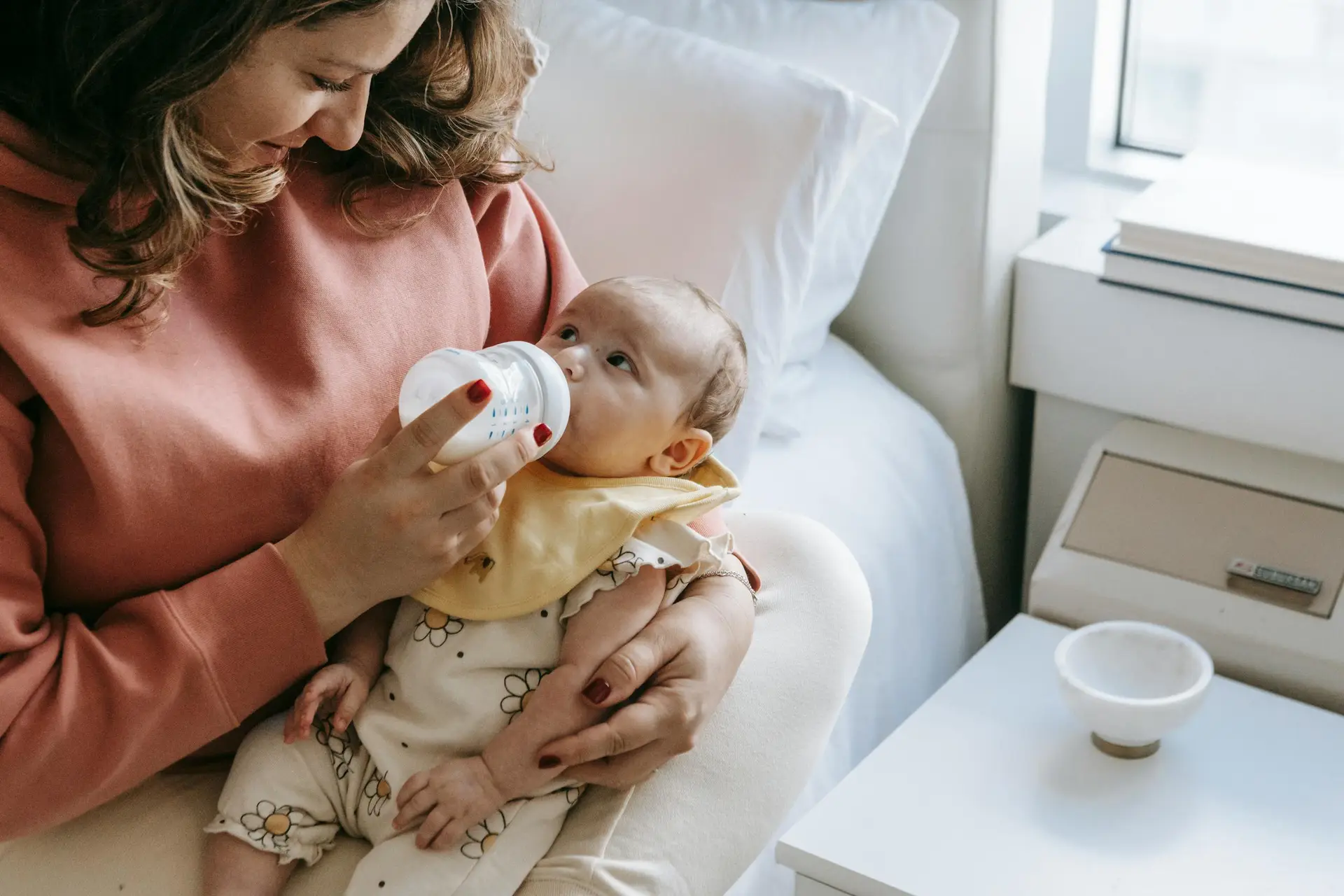
Why Parents Don’t Give Water to Babies Anymore
Babies under six months don’t need water. This surprises a lot of grandparents because a little water on a hot day seems like a basic common sense. It was, for a long time. Then the research caught up.
What the guidance actually says
Both the American Academy of Pediatrics (AAP) and the World Health Organization (WHO) recommend that babies under six months receive no water at all — only breast milk or formula. It’s the current consensus across mainstream paediatric medicine, and it’s based on how infant bodies actually work.
Breast milk is roughly 87% water. Formula, when properly prepared, provides the same. A baby under six months is getting all the hydration their body needs from every feed — even in warm weather, even if they seem thirsty. The feed is the water.
The stomach problem
A newborn’s stomach holds about one to two teaspoons. By one month, it’s grown to roughly the size of an egg — but it’s still very small, and it fills up fast.
When a baby drinks water, that water takes up space that should be filled with breast milk or formula. The result isn’t just a missed feed — it’s a missed dose of calories, fat, protein, vitamins, and minerals that the baby needs to grow. As Cleveland Clinic paediatrician Dr. Joanna Buckingham explains, giving babies water effectively dilutes their calorie intake at a stage when weight gain is one of the most important indicators of health.
For grandparents who are watching a baby and notice what looks like thirst between feeds, the right response is another feed — not water. Breast milk and formula will hydrate and nourish at the same time.
The sodium balance problem
This is the part that surprises most people, and it’s the more serious of the two concerns.
Baby kidneys are not mature enough to process excess water the way adult kidneys can. When a baby takes in more water than their kidneys can handle, the excess ends up in the bloodstream. This dilutes the sodium in the blood — a condition called hyponatremia, or water intoxication. Healthline explains that even small amounts of water can trigger this in a very young baby, because a baby’s kidneys are both much smaller and far less developed than an adult’s.
Symptoms of water intoxication include drowsiness, irritability, low body temperature, swelling, and in serious cases, seizures. It requires emergency medical treatment.
Why the advice was different before
For much of the 20th century, giving babies water was standard practice. It was recommended by doctors and passed down through families as common sense. So how did it become wrong?
The honest answer is that medical understanding changed. Research over the past few decades clarified just how complete breast milk and formula are as sources of both nutrition and hydration. A systematic review of 18 studies confirmed that breast milk or formula alone meets all hydration needs for infants under six months, even in warmer climates. The risks of water intoxication in young infants became better understood. And the AAP and WHO, reviewing the evidence, updated their guidelines accordingly.
After six months
Once a baby starts solid foods — usually around six months — small amounts of water can be introduced. The AAP recommends no more than 4 to 8 ounces per day between six and twelve months, and it should come alongside food, not instead of milk feeds.
Even at this stage, breast milk or formula remains the primary drink. Water is introduced gradually, partly for hydration and partly so the baby starts to learn how to drink from a cup. It supplements; it doesn’t replace.
What to do if you’re not sure
If you’re caring for a grandchild and genuinely aren’t sure whether the baby seems dehydrated or unwell, the answer is to call the parents. A baby who is getting enough feeds will have regular wet nappies and reasonable energy levels.
The parents have their paediatrician’s guidance to follow. Trusting that guidance, even when it differs from what you remember, is one of the more generous things a grandparent can do.